Buying Guide
Best Board Games for 8–10 Year Olds UK (2026)
Rated by Real Parents
Eight to ten is the age when children outgrow the dice-and-move games that filled their early childhood — but before they're ready for Risk, Settlers of Catan, or a three-hour strategy session. The games in this list sit in the space between: each can be taught in under fifteen minutes, each works for an 8 year old, and each is also genuinely engaging for adults sharing the table.
We scored them using a blend of Amazon ratings (40%) and qualitative sentiment analysis of real parent and reviewer discussions (60%) across 88,733 Amazon reviews and 223 scored parent discussions. Prices were checked in April 2026.
At a Glance
| Game | Age | Score | From |
|---|---|---|---|
| Labyrinth | 7+ | 82/100 | £13.98 |
| Carcassonne | 7+ | 82/100 | £26.79 |
| Kingdomino | 8+ | 80/100 | £17.39 |
| Exploding Kittens | 7+ | 76/100 | £15.99 |
| Sushi Go | 8+ | 76/100 | £10.49 |
Labyrinth
82/100Best first strategy game from age 7
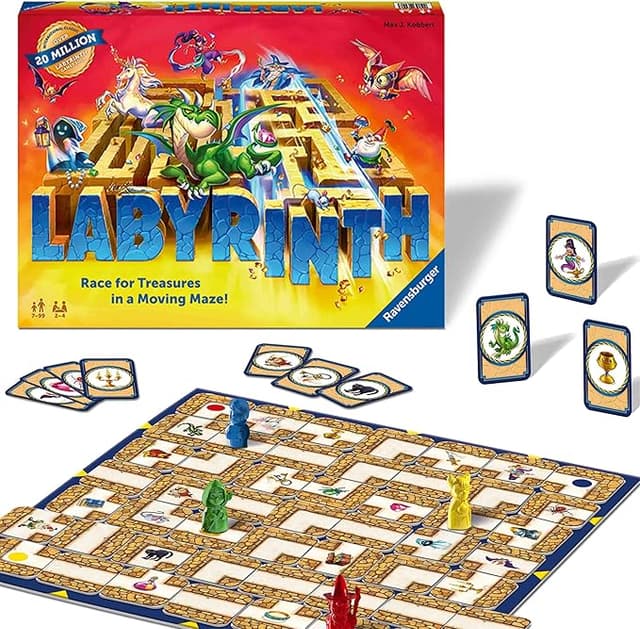
A grid of maze tiles sits on the board, one tile leftover. On your turn, you slide that spare tile into one of the rows, pushing the last tile out the other side — which means every turn the maze shifts, routes open and close, and nobody's plan survives more than one opponent's move. Your job is to navigate to your treasures and return to your starting corner first.
It tops this list on sentiment score (82/100) and has the highest positive rate here at 85%. The main complaint — about 12% of reviews — centres on the frustration of having your path repeatedly destroyed just as you've found it. For most, that frustration is precisely the appeal: the game forces constant re-thinking, and children at this age are usually ready for it.
“When I walked in mid-game all three family members — a 9 year old, a 23 year old and a 46 year old — were totally hooked. The 23 year old said it was a really good game.”
“My kids are 7, 9 and 15 and they all love this game! The game mechanic itself is easy to master but behind the simple turn-based game is a very strategy based game which can be made easy for young ones but can be very taxing for older players if you want it to be.”
“A fun game for the whole family. Simple game play, and will happily pass a few hours — but as every player moves part of the board your plans will be thwarted, which adds to the fun but can cause arguments.”
Best for: First proper strategy game — children grasp it quickly, adults don't find it boring, and it scales across a wide age range at one table.
Carcassonne
82/100Best gateway strategy game from age 7
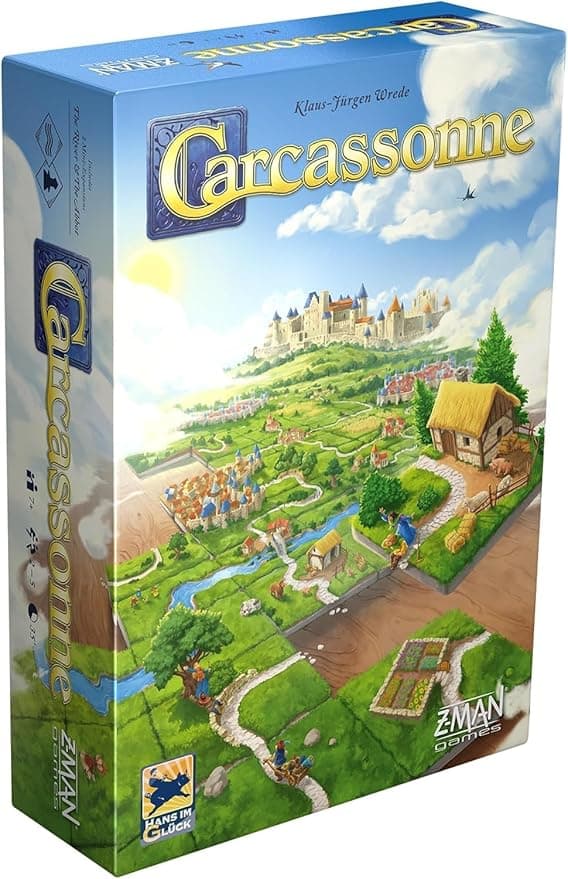
Players take turns drawing a tile and placing it to extend an ever-growing map of medieval France — connecting roads, completing cities, and claiming monasteries by placing small wooden tokens called meeples. Completed features score points; unfinished ones score less at the end. The rules fit on a single page, a full game runs around 30 minutes, and a beginner and a veteran can play together without the result being a foregone conclusion.
Carcassonne has the most scored mentions of any game here — 85 across YouTube and Amazon — making it the most data-rich recommendation in this list. The 20% negative rate mostly reflects competitive frustration (opponents blocking a nearly-finished city) rather than poor quality. The included River expansion is worth using from the second game — it spreads the opening tiles and avoids an early clustered board.
“This game is great to play with the family or just two people. The whole game takes about 30 minutes, whether playing with 2 or 4 people, and it's so easy to learn. We buy and try out a LOT of games — most don't get played more than a few times, but this one became an instant favourite.”
“This is a great game that I have played a good bit with my 8 year old, who loves it and is competitive. But it's fun for adults too.”
“The game play is simple to teach but strategic so you can continue to replay it and enjoy the game.”
Best for: Families who want a game that grows with the child — the strategy deepens the more you play, and expansions (sold separately) extend it for years.
Kingdomino
80/100Best quick strategy game from age 8
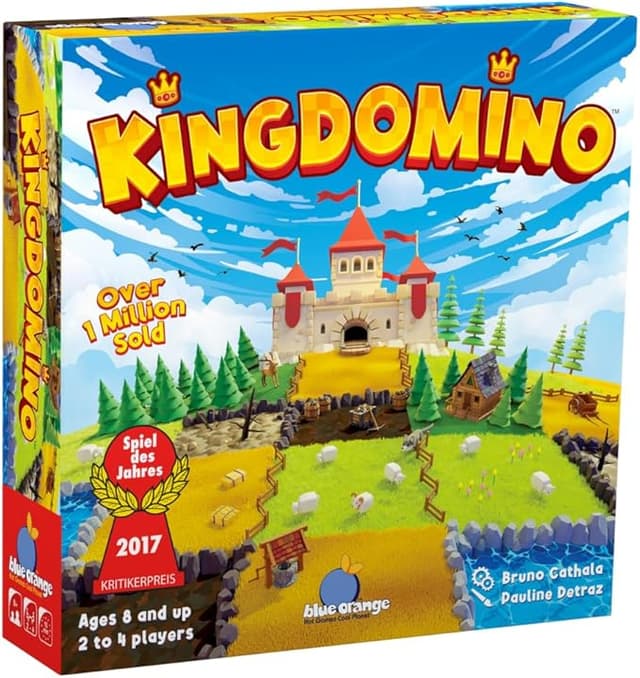
Kingdomino works like dominoes crossed with kingdom-building: each turn you pick a tile showing two terrain squares (forests, fields, lakes, mountains) and place it in your growing 5×5 grid, matching at least one edge to a terrain you already have. At the end, terrain patches score based on how many crowns appear on their tiles. The rules take under five minutes to explain and games run about fifteen minutes.
The 27% negative rate mainly comes from one specific issue: at two players the game loses some of its edge because the tile-selection mechanic is less punishing with fewer people competing. Three or four players is where Kingdomino shines. The game's Spiel des Jahres win reflects a genuine consensus that it punches above its price.
“KingDomino is a favourite game at our house. It's easy to learn and seems that anyone can win — not like some games that are geared toward certain mentalities or knowledge base. The game is in a small box, making for easy storage.”
“Great game! Really enjoyed the two player version. Quick and simple to set up and play, but also gets a little tricky when you have to start planning ahead for your next move!”
“Bought for playing with my daughter (she is 6) and wife. Very happy with this purchase, easy for understanding. We are playing 2–3 times per day, more than 6 months... and all cards still in perfect condition!”
Best for: Three or four players who want something genuinely strategic but completable in a single evening slot.
Exploding Kittens
76/100Best quick social game from age 7
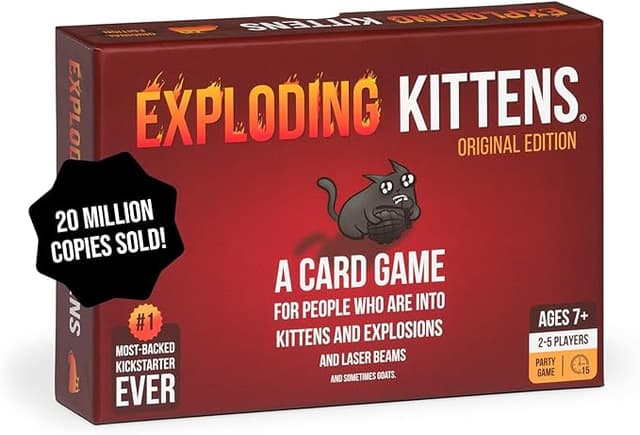
Exploding Kittens has by far the largest review base here — 57,000 Amazon ratings gives statistical confidence in its 76/100 score. The premise: a deck of cards, most harmless and tactical, with a few Exploding Kitten cards buried in it. Draw one without a Defuse card in hand and you're out. The game is primarily social — reading the cards, deciding when to attack, steal, or misdirect — rather than deeply strategic.
The 22% negative rate breaks down into two issues: YouTube reviewers score it meaningfully lower than Amazon (58 vs 73), suggesting extended play reveals its shallowness. And the social dynamics — stealing cards and targeted attacks — can create tension between competitive siblings. It also requires basic reading; younger children who can't read fluently will struggle. Treat it as a filler rather than a main event.
“I bought this as a family game to play with a 5 and 8 year old. Since playing it, it is the only game my boys want to play.”
“My 8 year old loves this and we do too. Very fun. No need for a big space to play it as it is only a card game with no board. Not suitable for younger children who can't read properly yet though.”
“Very fun! Easy to understand the rules. My youngest is 7 and she had no issues grasping it. Good family fun, I'm glad we added this one to our collection.”
Best for: A quick, social card game for families who already have a main strategy game and want a 15-minute warm-up or wind-down option.
Sushi Go
76/100Best value pick from age 8
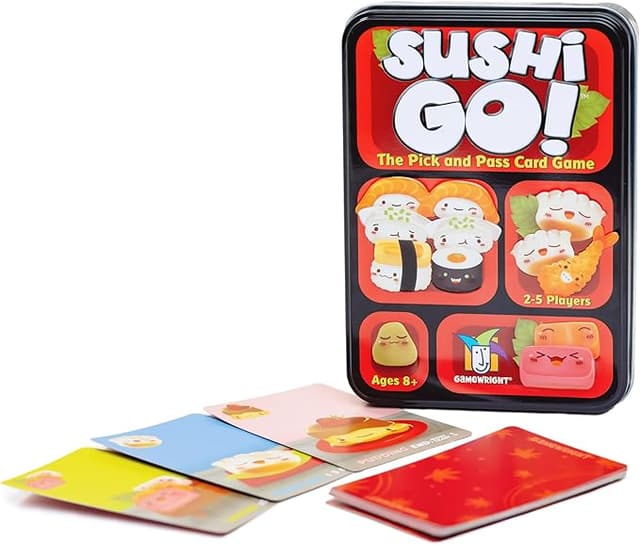
The mechanic is pure card drafting: deal a hand of cards to each player, everyone picks one and places it face-down, then passes the remaining cards to the next player. Repeat until the hands are empty, score your combinations, and play three rounds. The rules take two minutes and the logic of 'pick a card, pass the rest' clicks immediately for children and adults alike.
Sushi Go has the highest negative rate in this list at 31%. The main criticism is that experienced players find it too shallow after multiple sessions — the drafting decisions are interesting for the first dozen plays but the strategy ceiling is low. For a child new to card drafting, that ceiling is irrelevant; it becomes an issue later. It is the best-value option here at £10.49 from Zatu, and the tin packaging is genuinely good quality for travel.
“Sushi Go is a simple and intuitive game that encourages your child to think strategically. It's incredibly rewarding to see your child debating with themselves about which cards to play — do I get the 2 points now, or risk it and try and get the 6 points later?”
“We bought this game as a quick one that we could play as a couple, but also share with friends. Learning the rules may seem a little daunting at first, but it takes only one round before you master them. Each game still has good replayability.”
“We got this for a family holiday... This very quickly became our favourite. Of the three other card games we had, this was the daily game we played.”
Best for: Best value pick — a clean introduction to card drafting that's ideal for travel and quick sessions.
Which Board Game is Right for Your Child?
Highest positive rate in this guide (85%), intuitive mechanics, and works across a wide age range at the same table.
The strategy deepens the more you play, and expansions extend it for years. The learning curve is short; the depth is not.
Both complete in 15–20 minutes and work as warm-ups before something longer.
Significantly better at 3–4 than at 2 — the tile-selection competition is where the game finds its edge.
Both hold up well at 2. Kingdomino loses some of its edge; Sushi Go plays faster but feels thinner.
£10.49 from Zatu with quality tin packaging. The clearest value pick on this list.
Both are playable from age 7 with light adult support. Carcassonne and Kingdomino need sharper spatial reasoning.
About These Scores
Our scores blend qualitative sentiment analysis of real parent and reviewer comments (60%) with Amazon's normalised star ratings (40%) across 88,733 Amazon reviews and 223 scored mentions. Sample sizes vary: Carcassonne has the most data with 85 scored mentions and nearly 11,000 Amazon reviews; Kingdomino and Labyrinth each have 26. Exploding Kittens' 57,000 Amazon reviews make it the most-reviewed product on the site, though its YouTube score (58) is notably lower than its Amazon average (73). Prices were checked in April 2026.
Affiliate disclosure: links on this page may earn us a small commission at no extra cost to you. This does not affect our recommendations — all scores are calculated from real parent reviews, not editorial opinion.